TAKING CONTROL AT FABRIC – SEPTEMBER 2001
If fabric owner Keith Reilly and Most Technical’s Dave Parry share a common dream for the new London underground, it is to have their club DJs as studio engineers, sculpting three-dimensional sound up there in the club’s oxygen.
In an attempt to move the operation forward inside the exposed brick and chrome subterranea, Keith Reilly recently decided to raise the stakes in his landmark club.
The outcome was that their two-year-old JBL sound reinforcement system was replaced by a Martin Audio system in its two main rooms (including the manic Room Two) and shortly the more intimate Room Three will fall into line. “We’re looking at moving the sound in fabric to the next dimension with the Martin Audio system,” Keith Reilly commented after announcing his decision.
With an evolving Pro Tools production studio linked to the DJ station, as well as a Bodysonic dancefloor, it already had the means of inducting visceral pulses through its clientele. Add to that a TiMax spatialising effect, taking the output from the Martin Audio Blackline system on a zigzag excursion through space, and you have some idea why DJs like Sasha, Terry Francis and James Lavelle love this club as they strive to create sound from this processing resource rather than simply play music.
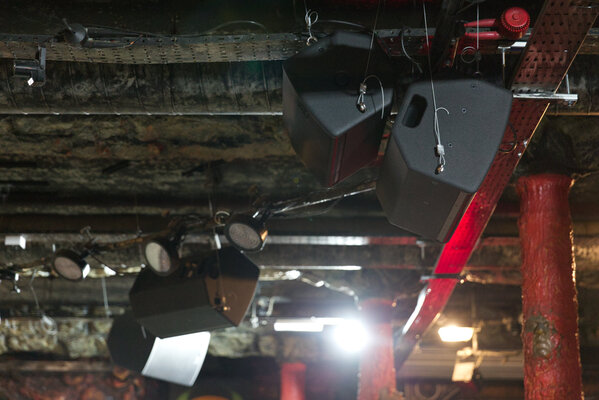
The Room One system has also been redesigned by Dave Parry, who is also fabric’s resident technical manager, in conjunction with Martin Audio’s product manager, Richie Rowley and the fabric sound team. Eight Martin Audio W8C compact enclosures were specified, formatted in a quad array around the dancefloor and underpinned by eight of Martin’s WSX monster sub bass units, which feature a single 18in drive unit on a 7ft S-shaped folded horn.
Earlier, the sound design for Room Two, which augments into a multi-channel spatial zoning arrangement with the TiMax system, had taken onboard the flagship products of Martin Audio’s Blackline range — the H2’s and H3’s.
The Martin order was placed through south-of-England pro audio distributors, Marquee Audio.
Yet the whole remarkable adventure had been predicated on nothing greater than a demonstration of Martin Audio Blackline F12 DJ monitors, which were starting to become something of a reference monitor amongst a number of the country’s finest DJs.
Rowley was starting to experience a ground-swell of positive feedback from leading club DJs such as Lisa Lashes, Judge Jules, Carl Cox and Anne Savage, who were finding it produced a more open inoffensive foldback sound used in conjunction with their subs. Rowley already had a relationship with Dave Parry and decided it was time to renew the acquaintance.
He set up a demonstration of the F12 monitors in fabric’s Room One and the quality of the produced sound — as well as the speakers themselves — was such that the monitoring system was immediately requisitioned for fabric’s flagship dance area.
Within ten minutes of giving the DJ monitors the thumbs-up, Keith Reilly was asking ‘What do you suggest for Room 2?’ But what encouraged Richie Rowley to bid, in particular, was the club’s plans to incorporate a TiMax system.
While Room 1’s dimensions are landscape, Room 2 is portrait shaped and ideal territory for TiMax’s back-panning characteristics. Rowley advanced a design concept for Room 2 using Blackline. The four tri-amped horn-loaded H3’s (15in/10in/1in) are placed in a quad array format around the dancefloor, supplemented by a further four bi-amped H2 cabinets (loaded with a single 10in driver and a 1in horn) providing satellite fill down the length of the dancefloor. Each box has its own individual amplification and control — processed initially by TiMax and then by a BSS 9088 Soundweb digital network device.
Providing the bass extension are eight Blackline S218’s — four recessed under the stage (largely for the benefit of live acts), two at the rear and one at each side.
Blackline’s high end H3, H2 and S218 enclosures were originally voiced for the late-night entertainment and high-end club installation, and Richie Rowley sensed that having fabric onside would give the box extra credibility.
By the time Room 2 was completed in late February this year fabric was beginning to smell like team spirit, and suddenly, out of the blue, Keith Reilly asked Richie Rowley if he fancied a crack at Room 1.
He eagerly submitted a specification based on an original design he had created more than three years earlier, and brought Dave Parry and Dave Fly, his sound engineer, to Martin HQ in High Wycombe, Bucks.
The fabric Signature system was to comprise a pair of W8C’s with the spacing wedge of the fabric logo cut in. Rowley explains: “We had to create the optimum angle for the W8’s because they are more generally hung on chains from their flypoints on a rock ’n’ roll gig. 30°-35° is the optimum splay between acoustic centres so I was able to design a wedge to maximise this spacing.” The fabric logo was cut into the wedge, which the club is considering backlighting with birdies.
The W8 system is designed in a quad array — two boxes in each corner, with eight WSX’s under the stage providing a single point source. When touring bands play, fabric has the option of hiring in two further W8C’s, (from Capital Sound Hire), which can be ground stacked on stage. The previous JBL design had double 15’s in the air and double 18’s on the ground. Rowley rationalised that rather than having bass firing from all directions — sounding muddled since it could not be time aligned correctly — a single row of 18in drivers mounted on 7ft horns under the complete width of the stage to create a single wavefront of sub bass was the better option.
“It’s purely based on acoustic principles,” says Rowley. “I could squeeze all the WSX’s in perfectly. The dance floor stretches only 7m (from DJ box to the front of the stage) and it’s 16m wide. I suppose it’s excessive to have eight W8C’s filling that space, but the rear boxes act as more of a fill and are turned down in level, otherwise you will have a lot of weird things happening in the time domain.
“We believe in true horn design which needs little in the way of external processing — there’s no need for deconstructive EQ which destroys the amount of headroom in the system. If you put a huge boost of EQ in you are eating up valuable headroom in the amplifiers.”
He continued: “Martin Audio approaches things differently; we remove the typical 2in compression driver and replace this with a 6.5in cone driver and 1in compression driver, so splitting the frequencies usually handled by one driver across two. The 6.5in cone driver has its HPF (high pass filter) at 850Hz and this crosses into the 1in at 3.5K. The 1in takes care of the fairy dust while the 6.5in is almost the dedicated vocal driver.” From this they were able to generate 127dB on the floor, with just the first show of red lights on the amps.
The ongoing operational success of fabric has been down to its engineers — Dave Fly in Room 1, Sanj Bhardwar in Rooms Two and Three, as well as head of live sound Roberto Peroni (and Jai Hauchu in Room 2) who are constantly babysitting the DJs, and making adjustments from 10pm-6am three nights a week.
And Dave Parry emphasises: “No-one comes here just to play records anymore — the sounds DJs play here are unique to fabric and the facilities we offer are now starting to really get used.”
But let Roger Sanchez be the arbiter of the new sound system. The second time he played fabric the top DJ played a five-hour set — and when he celebrated his birthday there later, he insisted on playing right through the night.