

- Home
- Applications
- Houses of Worship
Designed for Worship
Sound that carries every word, to every seat.
Sound is how a house of worship carries its message — the sermon understood in the back row, the choir felt throughout the congregation, the whole room moving as one to the worship band. When the sound is right, no one thinks about it. They think about why they came. That's the only thing a system should be designed for.
Most worship spaces weren't built to sound good
Some are beautiful but acoustically hostile — stone, glass and hard ceilings that throw sound straight back at the congregation. Others started life as something else entirely: a gymnasium, a big-box store, a warehouse, now filled with drywall, folding chairs and a thousand people. A growing number are purpose-built auditoriums, designed for production first, sound second.
Whatever the room, the same system is usually asked to do two conflicting jobs — keep a single spoken voice crystal-clear one week, then let a full worship band and gospel choir hit hard the next, without reverberation or low-end cluster taking over. For multi-campus and streaming churches, there's a third job: consistency has to hold from the main sanctuary to the overflow room to the broadcast feed.
No two worship spaces are alike. Neither should their sound be.
A converted retail unit and a hundred-year-old sanctuary have almost nothing in common — except that a system designed off a shelf will disappoint in both. Martin Audio designs around the room: its shape, its surfaces, its seating, and the way the community worships. Line array optimisation places sound precisely where the congregation sits and steers it away from the walls, windows, balconies and bare ceilings that cause reflections. For smaller spaces, coaxial point-source technology delivers the same clarity and evenness from a far smaller footprint. It isn't a product.
It's a system design — and it starts with the room.
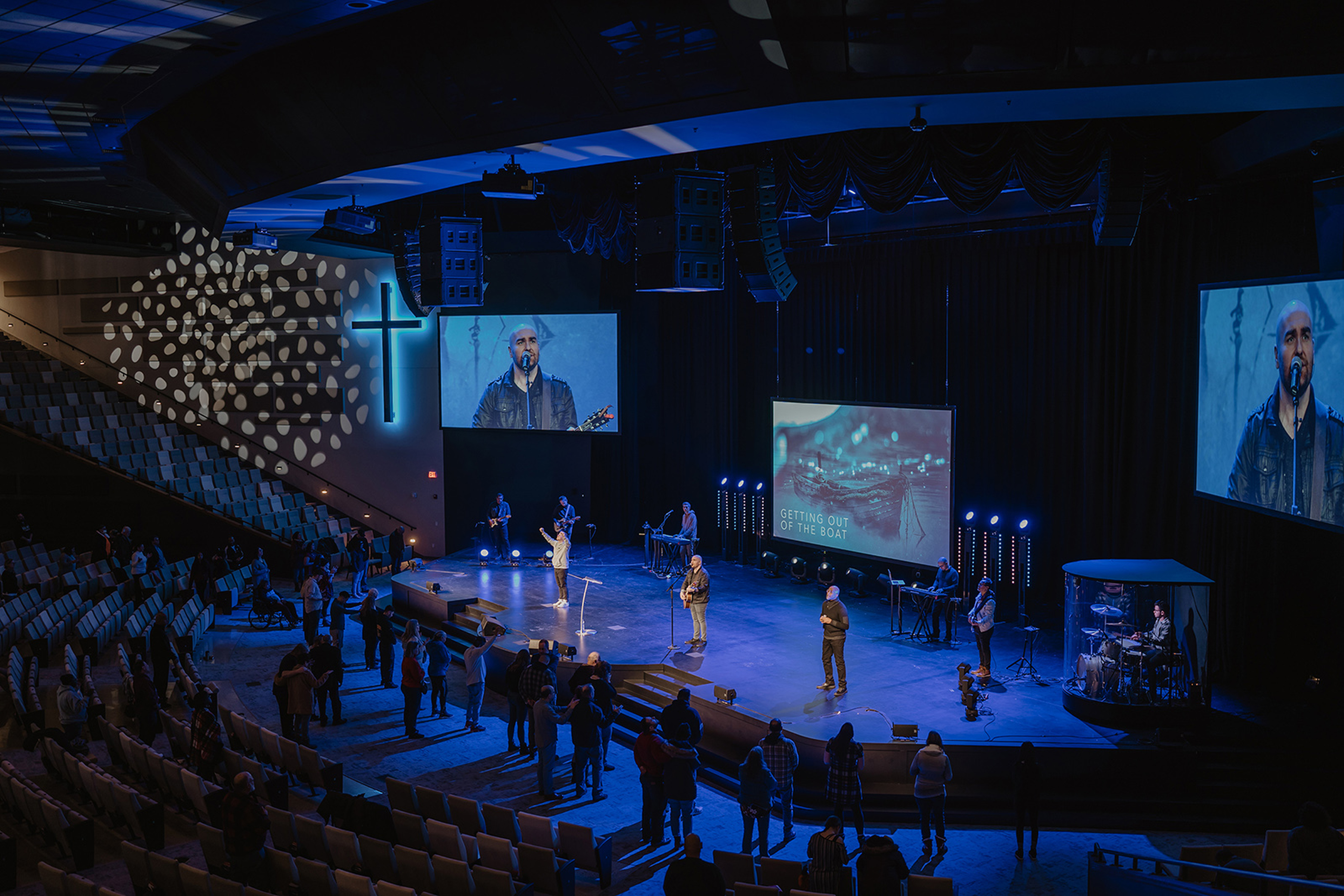
One family. Every kind of room.
Traditional or contemporary, ornate or industrial, 200 seats or 10,000 — a system for every room.
Wavefront Precision — larger sanctuaries, auditoriums and multi-campus venues
Full production, big congregations, highest-resolution pattern control that keeps energy on the people and off the hard surfaces — clarity and impact that hold from the front row to the back of the balcony.
In practice: Cathedral of Faith, San Jose, CA — a 2,200-seat sanctuary with a nine-piece band and choirs up to 200 strong. Wavefront Precision paired with CDD brought new articulation and warmth, and cleared the old speaker cluster from above the stage entirely.
TORUS — mid-size traditional rooms, fan-shaped auditoriums and flared contemporary spaces
Adjustable pattern control shaped to the seating plan, combining line-array clarity with point-source directivity — premium performance at a genuinely cost-effective price.
In practice: Grace Church, Des Moines, IA — a 1,200-seat fan-shaped auditorium replaced two decades of uneven coverage with even sound and subs moved out of sight.
In practice: Fellowship Bible Church, Sewell, NJ — a converted gymnasium tamed, with CDD zoning reconfiguring it into three distinct setups. "Speech is clear, music translates."
O-Line — rooms where the system needs to all but disappear
Historic sanctuaries, glass-and-stone spaces, anywhere sightlines and aesthetics matter as much as sound — discreet enough to vanish visually while keeping speech intelligible in the most reverberant buildings.
In practice: First Pentecostal Church, North Little Rock, AR — 40-foot ceilings, tile floors, 28-foot stained glass: beautiful, brutally reverberant. Discreet columns carry clear speech and rich music while disappearing into the room.
CDD — smaller rooms, fills, and distributed coverage in larger spaces
Class-leading coaxial coverage that works standalone in a compact sanctuary or as fill under balconies and across zoned, distributed systems in bigger rooms.
In practice: Calvary Church, Jupiter, FL — a wide modern auditorium running a distributed point-source system delivering clear, high-energy sound simple enough for volunteers to run. "Martin Audio makes phenomenal speakers."
Budget-conscious alternative — BlacklineQ
Wherever CDD or FlexPoint answer the need above — a standalone main PA for a small room, distributed fill supporting a larger space, or a portable system for quick redeployment — BlacklineQ delivers the same flexibility at a lower price point. It's the go-to when budget, rather than room complexity, is the deciding factor.
Heard in every kind of room.
A grand contemporary sanctuary. A reverberant chapel of tile and stained glass. A wide modern auditorium. A converted gymnasium. Congregations across the country, traditional and contemporary alike, have faced the same challenges — and heard the difference.
“Martin Audio makes phenomenal speakers.”
Calvary Church, Florida
“Speech is clear, music translates.”
Fellowship Bible Church, New Jersey
More Real World Worship Installations
O-LINE EXCELS IN HISTORIC TASMANIAN CHURCH
Launceston, TasmaniaHERITAGE BAPTIST CHURCH UPGRADES ITS PA
Zebulon, USTHE SOUND OF CELEBRATION AT THE CHURCH OF CASTEL
Mantua, ItalyCOLGATE MEMORIAL CHAPEL CHOOSES O-LINE
New York, USO-LINE SPECIFIED FOR HISTORIC NORTH CAROLINA METHODIST CHURCH
North Carolina, USLet us design yours
Tell us about your space
A few details about the room, the worship style, what isn't working today.
We design it
Our in-house team models the room in DISPLAY, the same software behind every install above.
See it
A bespoke design and an honest conversation. Ready to move forward, we'll work with you and our installation partners to bring it to life. Not ready yet, the design is yours to keep.
Frequently Asked Questions
For most churches, a full line array is more than the room needs. Line arrays earn their place in very large, high-ceiling or multi-campus auditoria, where sound has to travel a long way and stay controlled over distance — that's what Wavefront Precision is built for. Smaller and mid-size sanctuaries are usually better served by TORUS, O-Line or CDD, which solve the same intelligibility problem without the scale, or cost, of a full array.
Large sanctuaries need coverage that holds true from the front row to the back of the balcony. Wavefront Precision series is built exactly for this with WPM, WPS and WPC ideal for most such spaces, and WPL for the rare largest-scale project.
Historic buildings weren't built for speech — stone, glass and high ceilings throw sound back at the congregation rather than absorbing it. O-Line's discreet, modular design and dedicated optimisation software place sound precisely where the congregation sits, controlling reflections without a visually intrusive system.
Converted spaces — gymnasiums, retail units, warehouses — usually have hard, reflective surfaces never designed for speech or music, and often need reconfiguring for different events through the week. FlexPoint's compact, versatile point-source loudspeakers suit fast redeployment; TORUS suits a room that has settled into a fixed, larger-scale configuration.
Budget doesn't have to mean compromise. Wherever a small standalone system, distributed fill, or portable setup would normally call for CDD or FlexPoint, BlacklineQ delivers the same flexibility at a lower price point — the right choice when budget, rather than room complexity, is the deciding factor.
